


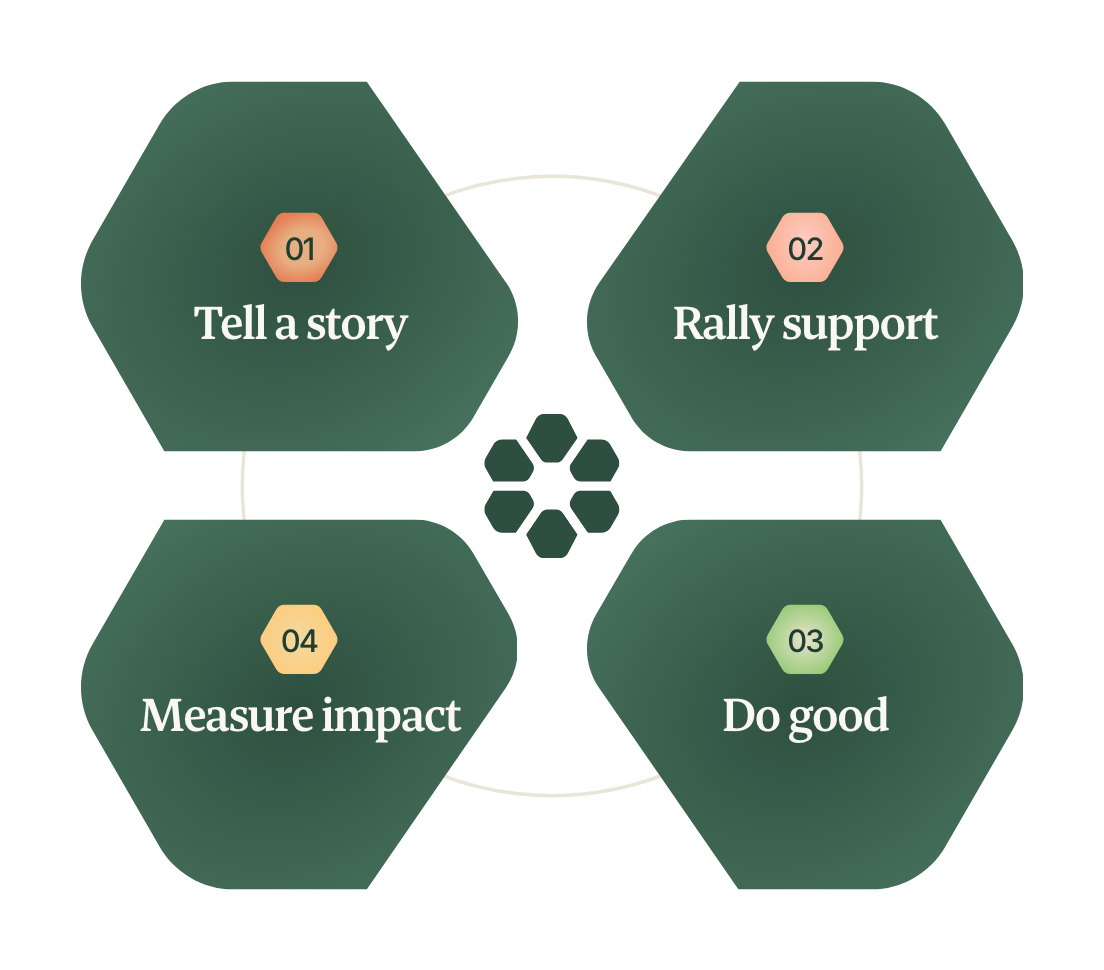
To refresh, the flywheel includes four components that work together to form a singular motion.
Good stories help us rally support which provides the resources to do good which allows us to measure impact which makes our stories more compelling and leads to more resources and so on.
All of this is built on software.
Compelling Story
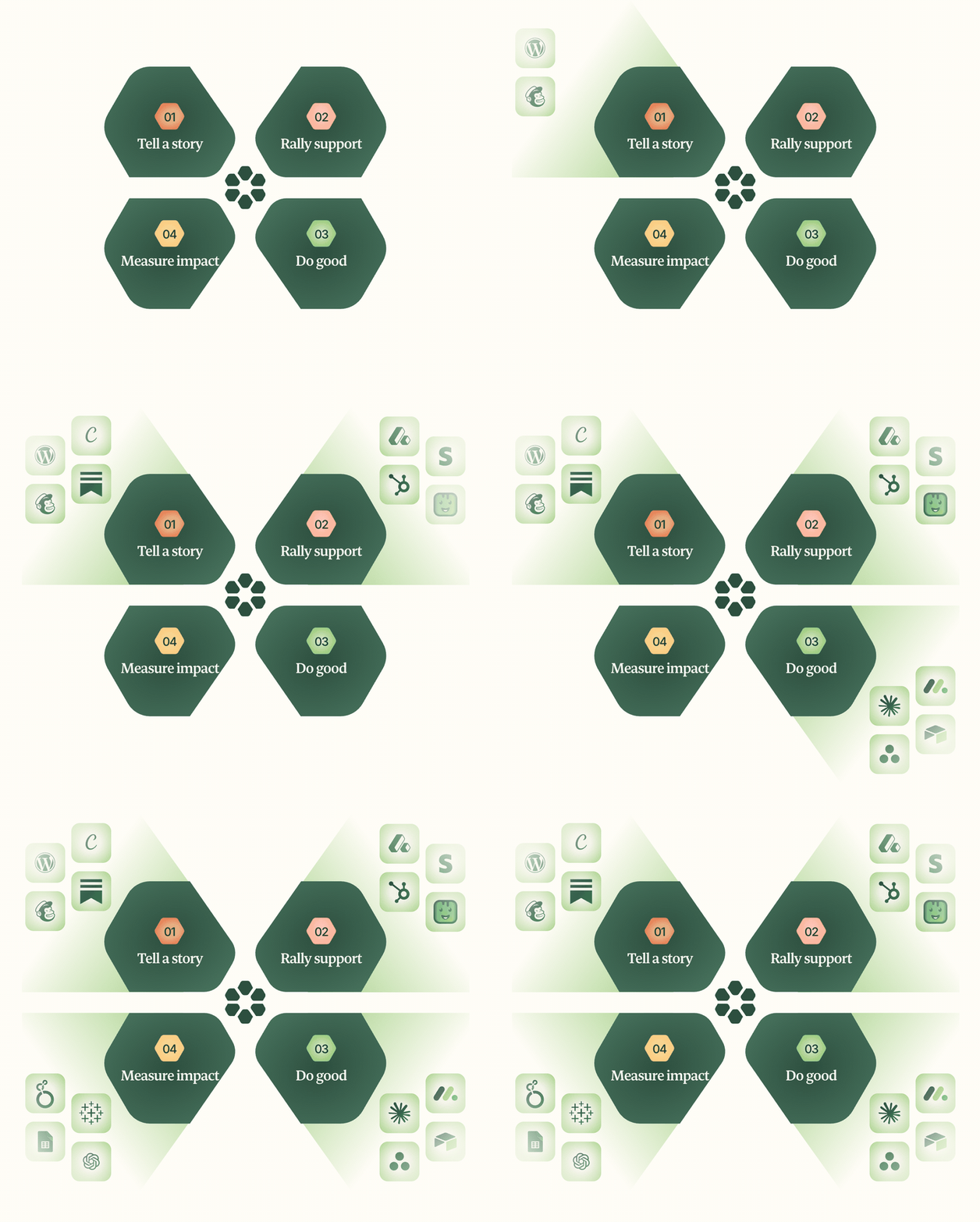
To tell a story, you might write a draft in Google Docs and have Claude review it for grammar and consistency with your voice. Creating the story isn’t enough. We have to distribute it to an audience. This is where software truly shines. When it’s ready to share, you’ll pass it to a designer who might convert it to a brochure in Canva or a board deck using Google Slides. Someone will update your WordPress website to reflect the new story, and someone else might send a version of it as an email to your subscribers in Mailchimp. Another person might convert the story to graphics for Facebook and Instagram or videos for TikTok. While the creative process of storytelling is very human (and sacred!), the distribution of that story is a software problem. If we want to be successful, we have to give our stories a chance to reach an audience, because that gives us a chance to rally their support.
Rally Support
A good story isn’t enough; we must call people to take action. That often happens from a landing page on a website with buttons that users click. (The buttons are called “CTAs”.)
We might ask our audience to register for fundraising events with Luma, donate with Givebutter or Donorbox, or sign up to be a volunteer with Typeform. If we are good stewards, we’ll nurture these relationships with regular emails using Mailchimp. And we’ll keep track of the texts and the phone calls and the coffee meetings in a CRM like Attio or HubSpot. Nonprofits are built on relationships, and people give to organizations they trust. When we earn trust, we receive permission to do the good we want to do in the world.
Do Good
People were moved by your story and donated to your cause. Now it’s time to do some good. You’ll create projects in Asana so you can track progress on big goals. You’ll communicate with your team with Gmail (so many emails) and Slack (so many messages), and you’ll create budgets and projections in Google Sheets and write project briefs and proposals in Google Docs. If you have embraced asynchronous communication (you should), you’ll diagram processes in Miro and record tutorials about how you work with tools like Loom. And don’t forget that you’ll need to account for the money with QuickBooks and pay your people with Gusto. So much to do!
Measure Impact
Doing good is great; demonstrating progress is better. Whether it’s pounds of food distributed, or water wells dug, or acres of land protected, you’ll measure your work. Maybe you have specialized software for this, or you use a custom database you built with Lovable or Airtable. And you won’t just capture quantitative data; you’ll ask open-ended questions and collect anecdotes from the people you serve, using Typeform or Qualtrics. And you won’t measure the impact alone; you’ll measure the flywheel itself. You’ll use Google Analytics and Sprout Social to see if people are seeing your story. You’ll look at Mailchimp analytics to see if people open your emails and click on your calls to action. You’ll use Givebutter and Stripe dashboards to see which people are giving you money. You might even need an analytics tool like Looker or increasingly Claude Code to roll up data from the entire organization.
Let’s do it for the right reasons
If you dislike software, I have bad news for you:
Successful nonprofits use software really well.
It has infiltrated every aspect of our work. Volunteers and stakeholders expect an elegant, intentional digital front door to your organization. Board members expect to read accurate reports that help them understand your work. Donors want to be able to give using ever-evolving digital payment methods.
If you want to meet people where they are at, you have to be able to meet them on their phone. If you are like me and that makes you a little sad, remember that if you meet them on their phone, you can invite them to meet you in person. :)
If you are feeling overwhelmed by all of this, please hear this:
You’re not alone.
Software is always changing, and it’s overwhelming. I’ve been in tech for over a decade and sometimes it feels like too much. You might see prognosticators on LinkedIn pronouncing “if you aren’t doing X, you are falling behind.” They act like we are being chased by bears.
There is no “ahead” or “behind.” No one is chasing you.
Don’t grasp for technology out of fear. Embrace technology because we have so much good work to do, and software can help.
As people who do good in the world, we need all the help we can get.
Until next week,
Ted
PS I don’t know lots of you and would love to meet. Next Tuesday (May 5th) at noon central, I’m hosting a Zoom call for any subscribers who I haven’t had the chance to meet. If you would like to join, just reply to this email, and I’ll send you the calendar invite.