



Every successful nonprofit does four things well.
- They tell a compelling story
- Which allows them to rally support (volunteers, donors, grants)
- Which provides the resources to do good in the world
- Which creates the opportunity to measure their impact
When they can demonstrate results… their story becomes more compelling… which allows them to raise more money… and do more good.
This is a virtuous cycle.
The foundation is an Impact Flywheel.
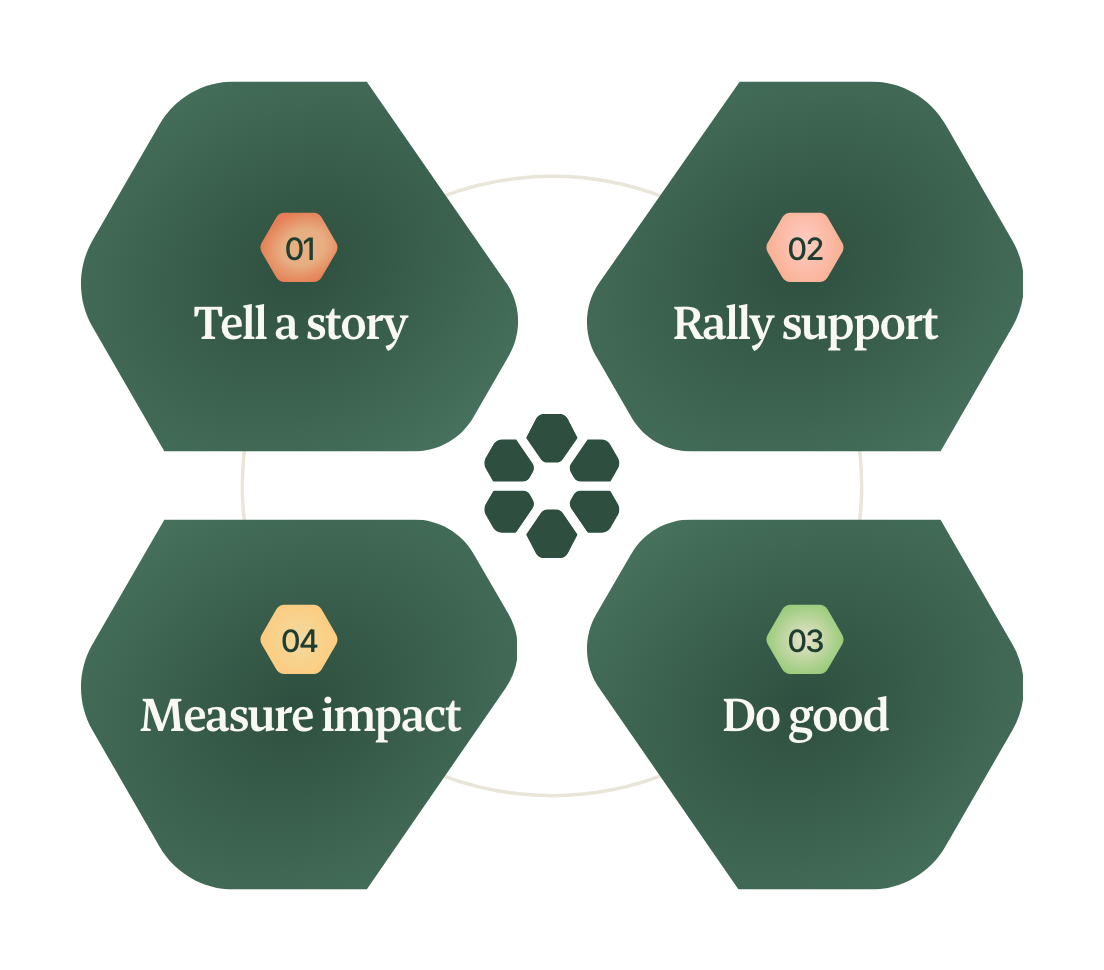
The flywheel was popularized by Jim Collins in his book Good to Great. You can read more about the concept here.
You’ll notice that “Doing Good” is only a quarter of the equation. For some, this may feel off. The storytelling and the rallying and the measuring aren’t “the work,” but merely supporting mechanisms for “the work.” I understand the sentiment, but I don’t think it’s helpful.
The book “The E-Myth” by Michael Gerber opens with a story about a woman who is an excellent baker. Her friends and family love her cookies, breads, and scones — and encourage her to start her own bakery. She does, only to find that owning a bakery requires her to be responsible for leases and equipment and employees and balance sheets and marketing and customers and taxes and software and so on and so forth. Two years later, she realizes that she owns a bakery but doesn’t have time to bake anymore.
Everyone should love their neighbor. Not everyone should start the neighboring movement.
Creating an organization from scratch moves our challenge from the problem at hand to the problem of scale. There’s a massive difference between baking bread for your family and friends, and building a bakery to feed a community.
When you go pro in the work of doing good, expectations rise. Your responsibilities increase. You are one of the few in the world who get paid to do meaningful work. That doesn’t mean the work will always feel purposeful. It’s work, after all.
Professional nonprofit leaders build systems that generate good. We can’t cherry-pick the profound parts and label them as “good” while minimizing the rest. To ignore the infrastructure required to do good is to pretend that cherries grow in grocery stores. We know better. The work of producing cherries includes the land and the soil and the labor and the picking and the distributing and lots of other things that I can’t imagine. (Writing this made me realize that I know nothing about cherries.)
When my wife and I started Eight Oaks, we planned to move to Ghana to care for eight girls in the Yellow House. Our board (in their wisdom) told us we couldn’t. Our job wasn’t the work of caring for the girls (which we desperately wanted to do), but the work of raising money. Others could care for the girls, but we were the only ones who could tell the story. Without the storytelling and the rallying, there would be no Yellow House. Which is to say:
Telling the story is the work.
Rallying support is the work.
Doing good is the work.
Measuring impact is the work.
Stop with the slicing and dicing. It’s all good. And necessary.
Honeystack helps nonprofits build an impact flywheel.
Because we believe in all of it. Behind the scenes or on the front lines or between the lines or in the weeds—everywhere and anywhere there is good work to be done. Honeystack wants to help.
To see the change we want to see in the world, we need stronger, more resilient nonprofits.
We need more nonprofits with flywheels.
But what does the flywheel have to do with software?
I’m so glad you asked. More next week.
Until then,
Ted