



If you’re in Wichita on November 11th, join us at 6:00 pm for a party celebrating two years of this newsletter, Thanksgiving, and the nonprofit sector. We have room for 40ish people. Reply to this email to save a spot, and we’ll confirm by November 4th. Not in Wichita? Tell us what city to throw a party in next.
Hierarchy of needs
If you are familiar with Maslow’s famous pyramid, then you know that he proposed that humans have baseline needs like food, shelter, and safety, as well as higher needs like understanding, beauty, and self-actualization. If the baseline needs aren’t met, people can’t appreciate the higher level needs. The theory has weaknesses, of course. People in danger or in poverty often find transcendence in moments of desperation. Nearly every religion recognizes fasting (ignoring physiological needs) as a path to transcendence. But for the sake of argument, let’s accept that this is true. People without clothes rarely reject new clothing because of their aesthetic taste and I would bet that most of you have not met a poor vegan.
Nonprofits have needs too. I charted each of Maslow’s rungs to experiences nonprofits have as they reach for higher needs.
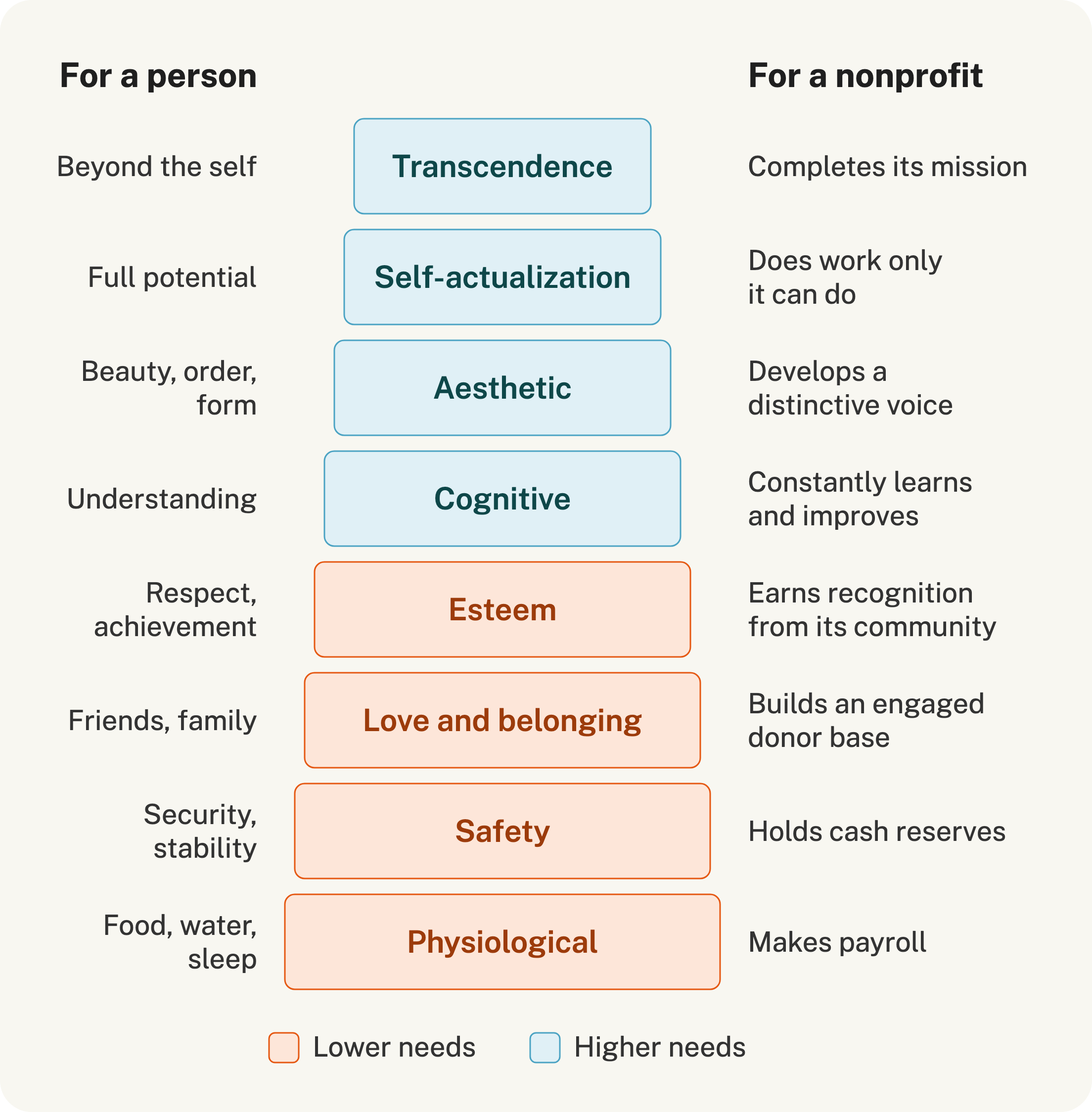
Making payroll Physiological
When CEOs are worried about making payroll, they can’t possibly attend to the higher needs of the organization. All of their energy will be focused on survival.
Holding cash reserves Safety
Once payroll is dependable, the next need is safety. If losing one donor would threaten payroll, the organization isn’t safe yet. Reserves large enough to absorb that loss give leaders room to think about the future.
Building an engaged donor base Love and belonging
A nonprofit goes beyond safety when it establishes an engaged donor base. Organizations begin to thrive when they have funders who care deeply about the cause, feel alignment with the mission, and are committed to supporting the work for years to come.
Earning recognition from its community Esteem
As an organization finds success, it needs to be recognized by its peers, its community, and its donors. I’ve heard many nonprofits say in their strategic plans that they want to be leaders in the nation for their cause. That isn’t vanity. They are proud of their work and deserve recognition.
Constantly learning and improving Cognitive
Above esteem, Maslow placed the need to know and understand. As organizations mature, they have the freedom to become curious. To ask hard questions. They can hold their work up to a mirror, evaluate outcomes, and learn and grow. They begin to act experimentally.
Developing a distinctive voice Aesthetic
Maslow believed people need beauty, order, and form. It’s easy to dismiss this one as vanity, but it’s a sign that someone took the time to care. At this stage, organizations begin to pursue excellence in all things. An organization that develops its own voice, look, and way of doing things establishes something that will live beyond the people who work there today.
Doing work only it can do Self-actualization
“What a man can be, he must be,” Maslow wrote. For a nonprofit, self-actualization means doing the work that only it can do. Organizations at the bottom of the pyramid follow the money and drift towards funding rather than staying anchored to their mission. Organizations at this level know exactly what work they were made to do, and have the security to turn down opportunities that aren’t aligned with their identity.
Completing its mission Transcendence
For a nonprofit, transcendence means caring more about the mission than about the organization. The most successful nonprofits in the world are the ones that drive themselves out of business by accomplishing their mission. This is the rarest of all nonprofit feats.
Talking past each other
I frequently find myself talking past nonprofit leaders. What I believe is important is often not valued the same way by my nonprofit friends. A stellar mentor of mine suggested that maybe I’m trying to meet needs at different rungs on Maslow’s ladder.
A conversation with one of my clients popped into my mind. I was trying to persuade them to leave Salesforce. I described the ways it wastes resources and how the absurd complexity of the platform discourages people from collaborating. I had many more reasons, but do you know what one of my biggest motivations for helping them leave Salesforce was?
Because it’s ugly.
My reasons are aesthetic. Salesforce is some of the ugliest software I’ve seen. Some might say that changing software because you don’t like how it looks is ridiculous, but I’m convinced it’s as good a reason as any. Aesthetics are not only how things look but how they feel. Beautiful form requires excellent function. We spend most of our working lives looking at screens. I believe it’s bad for culture to make people look at ugly software all day. I would go one step further: it’s bad for our souls. People were made to seek beauty.
My client was not persuaded, but I hope I planted a seed. My goal is not that they leave Salesforce (although they should) but that they would embrace beauty and excellence in everything.
I admire nonprofits that always find a way. Scrappiness is an important value, but an impoverished way to live. If we want to solve the world’s most pressing problems, we can’t do it with organizations on life support. We need funders who want nonprofits to do more than just survive. To change the way things are, we’ll need nonprofits that can reach for something higher.
Beautiful software would be a great place to start.
Until next time,
Ted