




Nonprofits have an invisible debt on the balance sheet. They were founded by people who put in years of unpaid labor to get the organization off the ground. Once a nonprofit makes it, how do we acknowledge the founder’s sacrifice? Most boards ignore it entirely.
Startups with very different incentives
When a for-profit startup succeeds, the founder is rewarded with control of the company. They can’t be fired, they set their own salary, and they receive distributions of the profits. Founders make a bet that the value of the company they build will be worth more than the salary they give up in the process. For many, this is a bad bet. For those that make it, the success is life changing. High risk; high reward.
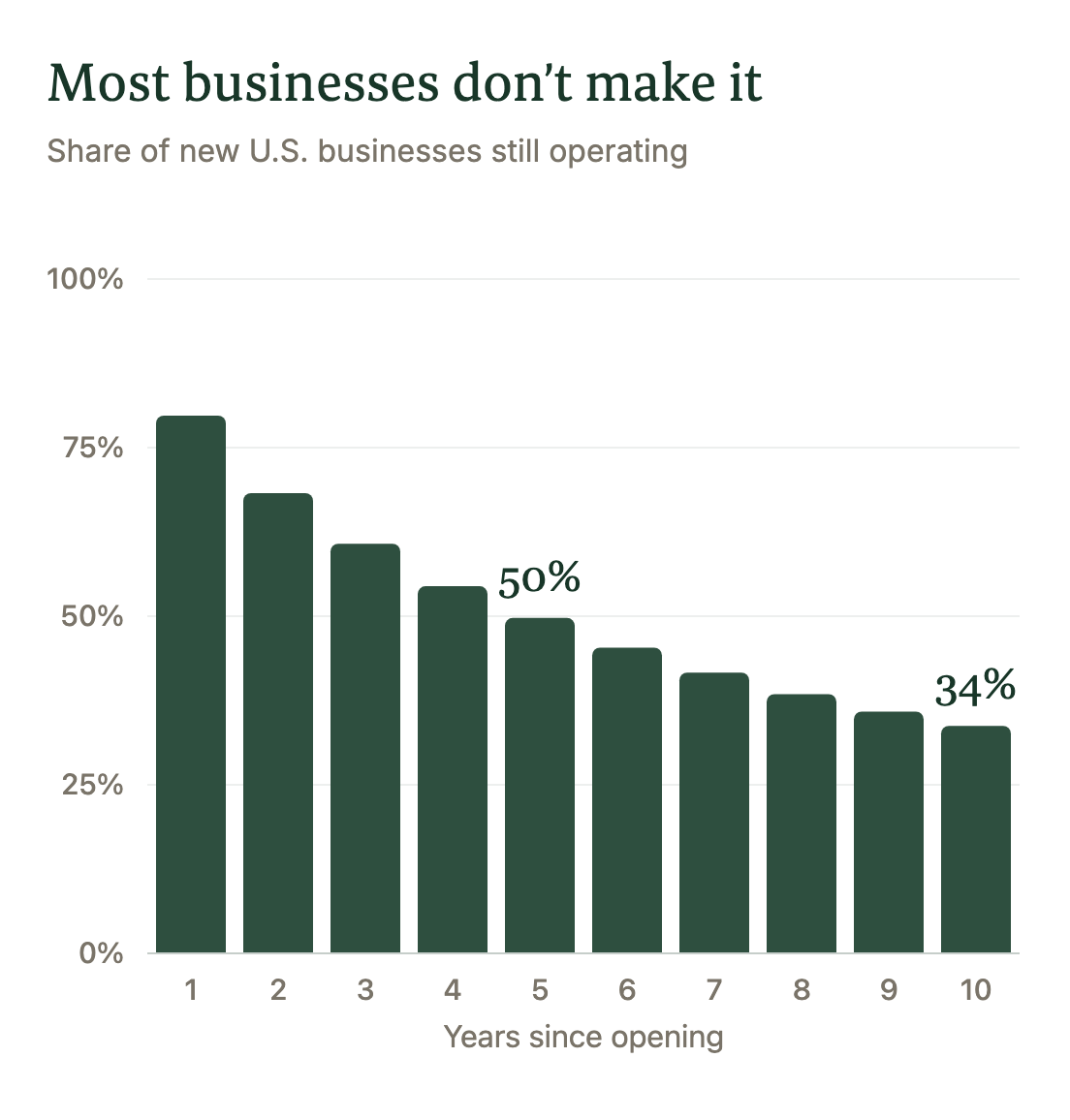
Source: U.S. Bureau of Labor Statistics, Business Employment Dynamics — survival of private sector establishments born in 1994.
What about nonprofit founders?
Founders of nonprofits do exactly the same work to create an organization. They establish a brand, build some momentum, and articulate a unique purpose in the world. (They also do fundraising, accounting, marketing, operations, and all the things.) Most of these founders also go years without pay. Like all startups, many nonprofits fail to take root, but some beat the odds and build organizations with sustainable revenue, strong teams, solid brands, and a respectable niche in their community.
The reward these founders receive in return? Ten bosses and a mediocre salary.
Nonprofits are assets
Nonprofit organizations (like for-profit companies) are assets. The only difference is who owns them. For-profit companies belong to shareholders, and nonprofit organizations belong to the public. A museum with $100 million of assets could be incorporated as a for-profit or nonprofit with no meaningful difference in day-to-day operations. Both might charge admission, buy or sell buildings, and hire and fire employees. Both have a balance sheet. Both are valuable. (One just doesn’t have to pay taxes on earnings.)
But how valuable?
If we treated a nonprofit organization that earns $1 million per year in revenue like a services company, it would be valued at somewhere between 0.4x and 1.5x revenue.
| Business type | Revenue multiple | Source |
|---|---|---|
| IT services | 1.1x | Aventis |
| Marketing agency | 1.0x | Axial |
| Home services | 0.7–1.5x | CT Acquisitions |
| HVAC | 0.8–1.2x | CT Acquisitions |
| Electrical | 1.0–1.5x | CT Acquisitions |
| Landscaping | 0.4–0.7x | CT Acquisitions |
Which is to say, the founder of this nonprofit has created somewhere between $400k and $1.5 million in value for the public. Incredible! The ability to turn $0 into a million dollars is magic!
But the magic wasn’t free. These organizations are built on unpaid labor.
Founders of nonprofits deserve backpay.
But how could we?
To be clear, not every founder should earn backpay. In fact, most shouldn’t. (I’m a founder of a nonprofit who wouldn’t make the cut.) Roughly 8% of nonprofits make it to $1,000,000 in revenue per year. For simplicity, I’m going to use that number as the threshold of success before someone qualifies.
Here are three ways we could do it:
Pay them back. This one is quite simple. Take the median salary for the country multiplied by the years the founder worked without pay. Give them a lump sum, or pay them out over a few years. If cash is tight, create a 30-year payment plan. This probably drastically undervalues their contributions, but considering the current standard is $0, I’m trying to be reasonable.
Give them a parachute. When they leave, they get an off-ramp that matches the number of years they worked without pay. If they worked for three years before their first paycheck, they stay on payroll for three years after they leave. I love this one, because it gives them the runway to start something new. Boards would need to be careful drawing this up so that they don’t encourage their golden goose to fly the coop before the time is right. (How about folding the off-ramp into a succession plan?)
Invest in their 401k. Founders are risk takers and, based on my own anecdotal evidence, horrible retirement planners. Take the money that they should have earned and set up a retirement account for them.
A few parts are tricky
To be fair, paying back founders would require some nuance. For instance, what if there were two founders? What if their contributions or sacrifices were not equal or they started at different times? What if they took small salaries, but not market-rate ones? In for-profit startups, these questions, and many more like them, are sorted out in a shareholders’ agreement. Nonprofits don’t have that mechanism. Some will say that this complexity is why we shouldn’t pay back founders at all, but not knowing the amount of the debt doesn’t make it go away. Most boards have a lawyer, and this is the perfect opportunity for them to flex their muscles. These are the people who brought us concepts like phantom stock and shadow equity. Lawyers love to be creative!
Founders might say, “I knew what I was getting into. I would do this work for free!” (Yeah, we know.) While I love that aw-shucks humility, that also isn’t the point. A debt was incurred. The question is not whether founders want to be paid back for their unpaid labor, but whether we should.
It’s in the public’s interest
I think it’s bad for the public to ignore the sacrifices people make for us. (Our lack of care for veterans is a prime example.) I believe nonprofit boards, as representatives of the public, have a responsibility to acknowledge this debt that doesn’t show up on the balance sheet. When founders build successful nonprofits, they should be rewarded, or at the very least, made whole. They’ve enriched our communities! If we don’t acknowledge their sacrifices, what does it say about us?
Until next time,
Ted