


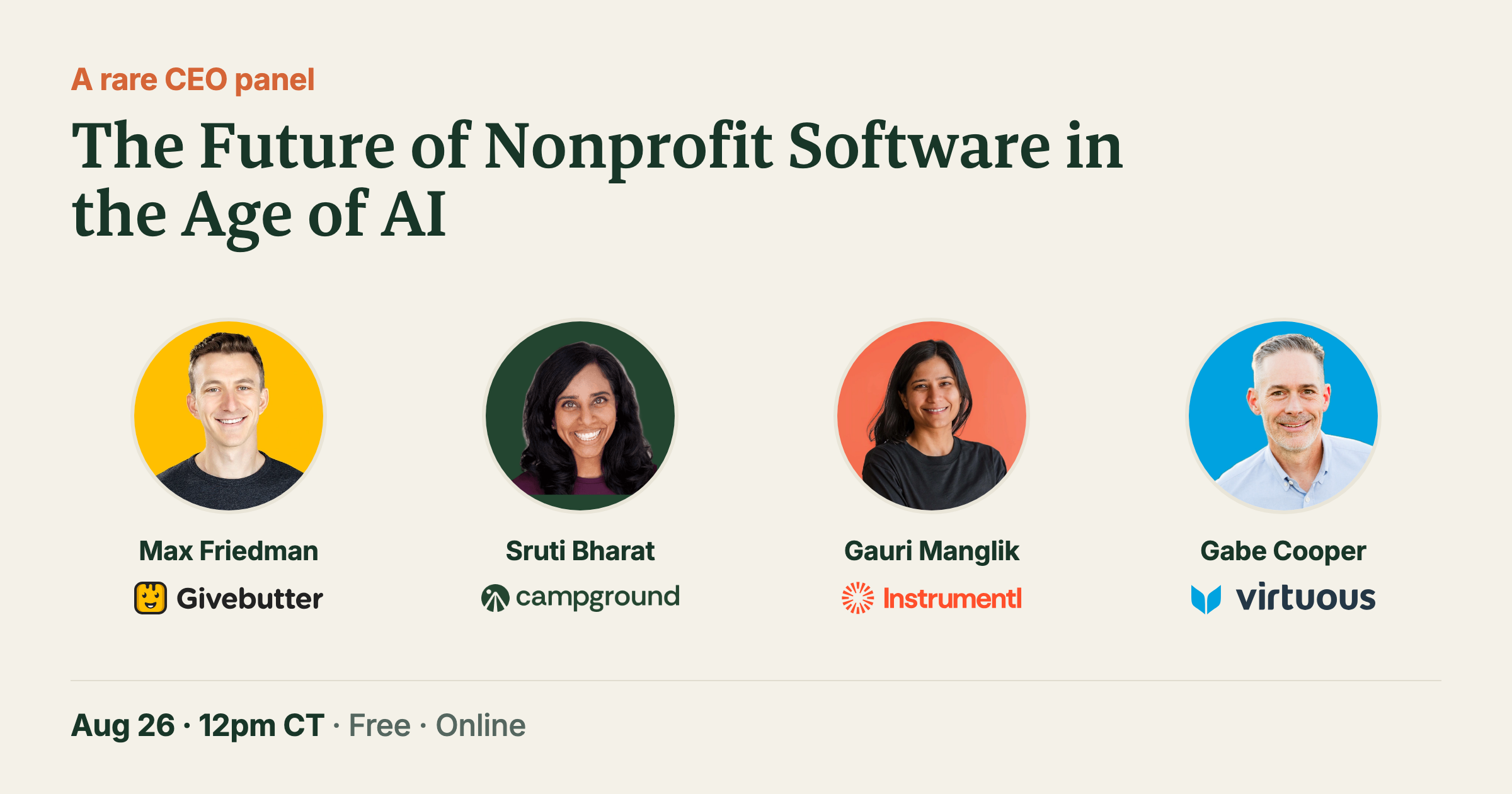
Last week, I moderated a panel with four nonprofit tech CEOs: Max Friedman, Gauri Manglik, Sruti Bharat, and Gabe Cooper.
I wanted to know how each of these leaders were adapting to this new era of software.
Three things stood out to me.
They are responding with courage
None of these CEOs had integrations with ChatGPT and Claude on their roadmap four years ago. (ChatGPT released in November 2022.) They’re learning and changing in real time.
I asked Gauri directly: does that make you nervous that the surface area is expanding away from your product and into other products?
“I feel like as a CEO, you don’t get to be nervous. Change is the only constant. And so you’ve got to just fully embrace it, and learn how to love it.” — Gauri Manglik
Gabe shared:
“You trust that your software is good enough to withstand opening up the world, but it’s the way we’re going.” — Gabe Cooper
And Sruti admitted the fear underneath all of it:
“When AI came out, there was a moment: is all of software just dead? And everyone’s gonna build their own?” — Sruti Bharat
My observation in response:
“It takes a tremendous level of courage as a leader to hold your products that loosely… You’ve probably seen other software companies try to close in around customers and say you can only use the AI we bolt on. The way you hold your product loosely, I find really admirable, and courageous and risky.”
They didn’t demo their own product
Max, Gauri, and Sruti didn’t show me Givebutter, Instrumentl, or Campground. They showed us how their product is changing through the lens of Claude and ChatGPT. Rather than try to lock their products down, they are opening them up.
Gauri shared:
“Our UI within Instrumentl and the agents we build within Instrumentl are competing with the agents our customers might choose to build themselves. And that’s good; if they can build something better themselves, they should be totally allowed to do that. Hopefully they choose our system of record to build on top of.” — Gauri Manglik
Max echoed:
“I love this idea that you’re competing with the agent. It’s about who can do it better: if it’s the agent, awesome. If it’s us, awesome. If it’s another player, awesome.” — Max Friedman
Fall in love with the problem, not the product
I asked all four how they’ve had to change their roadmaps as AI reshaped what’s possible. Gabe’s answer was the one I keep coming back to:
“It’s easier if you fall more in love with your customer’s problem than your own solution. If the thing you’re focused on is solving a problem, you’re not married to your particular way of solving it. So when something like AI happens, you see it as all opportunity, not risk, because the thing you care about is solving the problem.” — Gabe Cooper
We weren’t planning to share the recording, but enough of you asked that we’re posting it. We live to please. You can watch the full roundtable here.
The world is too big and too complicated for any one of us to go it alone. Software companies and nonprofits aren’t all that different. Neither is naturally inclined to collaborate, but everyone knows it’s the only way forward. It takes a special kind of courage and humility to remain open to change, and I’m thankful for the way these CEOs are leading the way.
Until next week,
Ted